HOW IT ENDED UP…
What makes Knightfall such a classic story is how it defines the Batman franchise in ways that resonates to the modern day, despite its biggest thematic values having been memory-holed with the passage of time and new generations of fans.
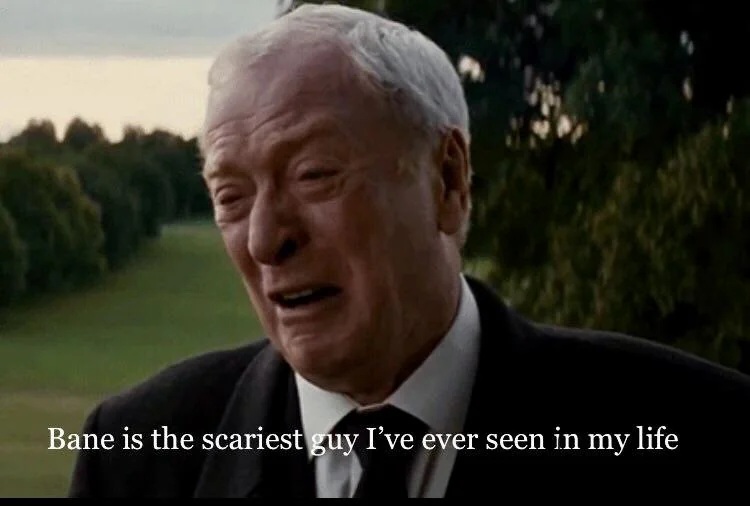
For example, the character of Bane is comparable to other popular comic supervillains created around the same time such as Doomsday or Venom in how the challenge he presents to the hero is realized by intense violence and a peculiar psychology, endemic to actions films of that period. Whereas the traditional Batman villain typically leads with psychosis-powered gimmicks such as coins or plants, Bane’s methods involved observation and planning. For a character like Batman who overcomes challenges with his mastery of intellect and athleticism, Bane was a perfect opponent. It’s why if you asked anyone for ten years after Knightfall who Batman’s top three villains were, Bane would regularly rate highly. What brought him down in the zeitgeist were subsequent comic appearances with lesser stakes (he kicks the Venom addiction in later stories) and media appearances that quickly typecast him as a powerful brute with little else to offer. 1997’s Batman and Robin is the worst offender, but his appearance in Batman: The Animated Series where he’s dispatched fairly easily didn’t help either. By the time of 2004’s The Batman cartoon where he appears and is defeated in the third episode, it was a wrap. It would take eight years for The Dark Knight Rises to return dignity to the character, and even then it still wasn’t adapting Knightfall.
There’s also Knightfall’s length, with the significant events chronicling a full beginning, middle and end, delivering what is tantamount to a true comic book epic. Because Bane isn’t the main character or even main antagonist of the story, it’s Jean Paul Valley a.k.a. Azrael. His arc speaks to the changing trends of action storytelling in comics, reflecting a prescient theme that still resonates years later. His story begins with a four issue miniseries before the events of Knightfall take place; it would always be difficult to present the details necessary for a fully-functioning translation.
But we’ve had several examples of adaptations tackling long-form storytelling. We’ve had a number of multi-part films to know the limits of what they can do, and what they can present in a matter of seconds what originally took pages to communicate. In many ways it’s taken the last twenty years to lead up to this moment.
So how is it? Let’s go through it.
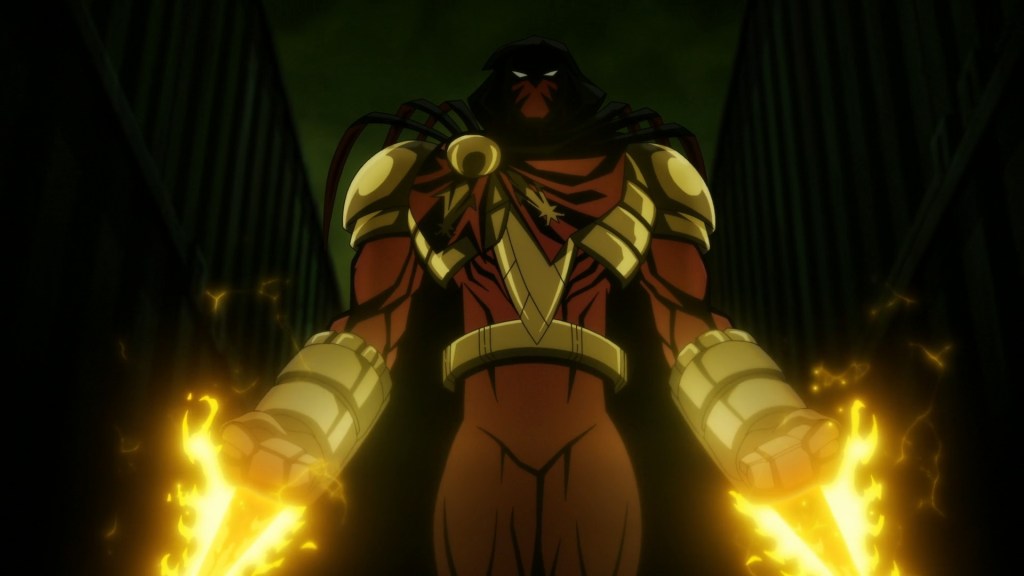
We begin with a five minute introduction of Azrael, utilizing nothing from the four-issue Sword of Azrael miniseries. This was always completely necessary, and something I expected from the start. Azrael/Jean-Paul Valley is a graduate student-turned – Manchurian Candidate-esque sleeper agent for an ancient order of assassins brainwashed from birth to rid the world of evil. None of that is detailed in this scene, or in the film really. Just enough is shown that Azrael is a deadly menace to criminals everywhere, demonstrated by him slicing the faces off of human traffickers with his radical flame-swords.
This is also where the majority of the film’s “R” rating is justified, something I also expected. A lot of fans online kicked their feet up in excitement for Knightfall to get the “R” treatment, but as opposed to more execrable examples of adult DC media like Titans, this is mainly the result of the animated violence as opposed to language or anything else. The rest of the film’s action plays out about the same from the comic, so the story’s content wasn’t punched up for clout. Make no mistake, this opening scene is quite graphic, but it’s also logical for storytelling’s sake.
After the credits, we’re presented with a scene tagged “Years ago” on the Caribbean island of Santa Prisca, taking place in the Peña Duro prison. A woman gives birth and is horrified to learn its a boy. Cut to the warden barely containing an evil smirk as he confirms that the boy will live out the prison sentence of his unnamed biological father. All of this is 100% adapted from the one-shot Vengeance of Bane written by Chuck Dixon and illustrated by Graham Nolan, down to the portrait on the warden’s wall.
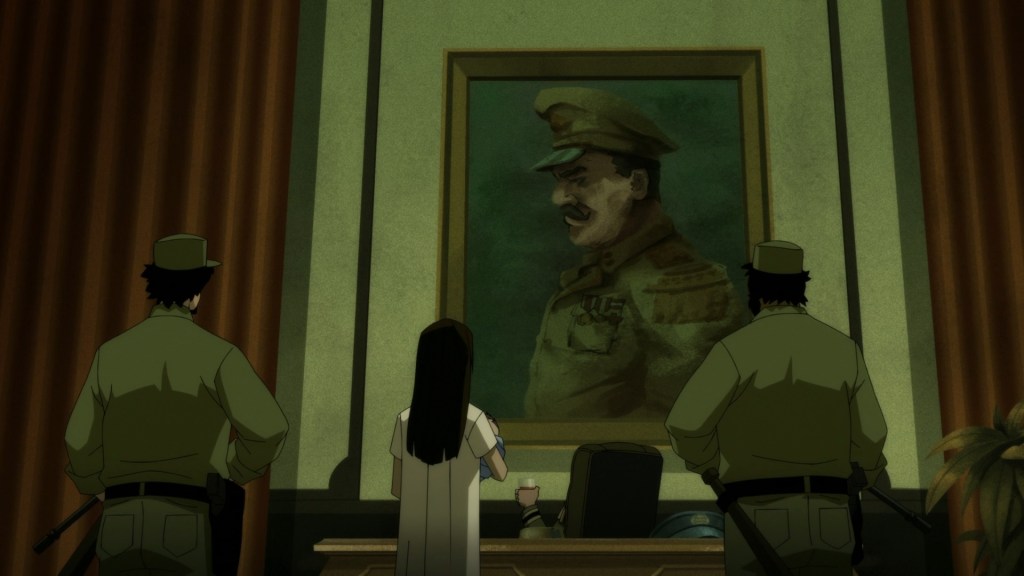
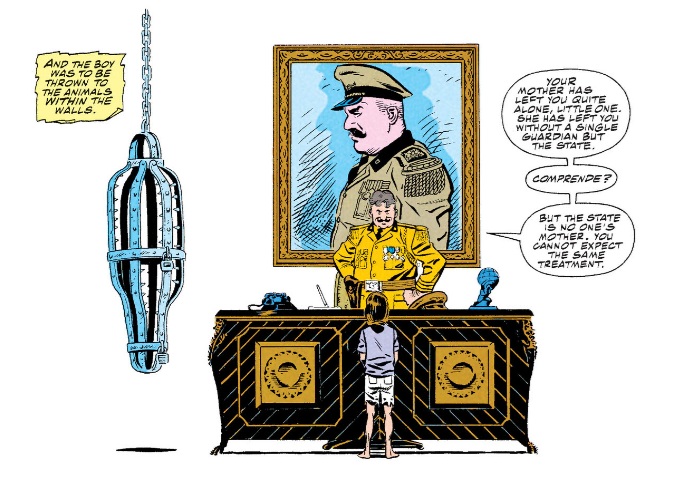
What follows is a natural progression for the adaptation. In the comic, the mother has no dialogue before she passes away from an untreated illness. Here, writer Jeremy Adams has her instill in Bane the understanding that might makes right, and that the powerful are the only ones made fit to survive. Even when he steals food for her, she admonishes him for expressing compassion, showing her own for him by ingraining the value system which will keep him alive for the next twenty years.
But it’s here where we get our first genuine alteration to the original story, in Bane’s motivation. Given American reading material, he sees a feature article on Thomas Wayne, boasting how his (medical?) business has made Gotham City the pride of the country. He sees Wayne – his wife and son held close – as a pillar of strength and vows to make himself worthy of earning similar status in the world. Over the years, as he’s held in solitary confinement for murdering pedophilic janitors in self-defense, he fixates on the magazine, as it drives him to build his body into a towering mountain of muscle.
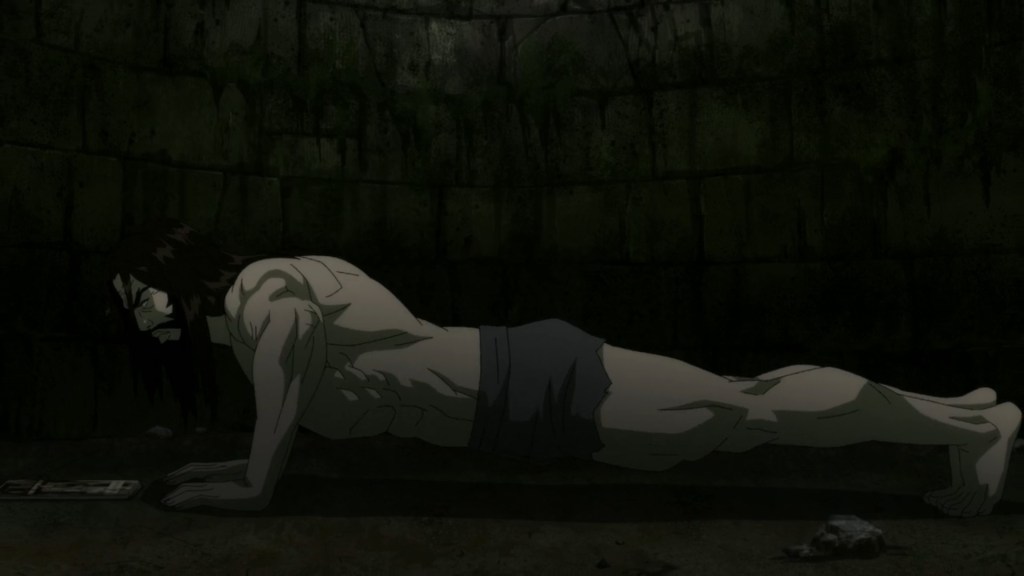
This is not how things went in the one-shot. Originally, Bane’s confinement resulted in him being haunted by dreams of his ideal, powerful self, and those dreams spurred him on to master his own body. Inspiring the fellow prisoners, he made friends with a certain inmate from Gotham City (more on him later) who provided him with several books and reading material, teaching him how to read in the process. The stronger Bane grew, the more he used his influence to have books smuggled into the prison. As the years went on, he killed challengers to his BMOC status and yearned for stronger adversaries outside of the prison walls. That’s when his criminal friend told him of the legend of the Batman of Gotham. Describing Batman as the ruler of his city, Bane made him his goal and set his sights on escaping Peña Duro.
I like the OG backstory but don’t fault the new one. I understand cutting several characters down to various extras and the prison warden. One might question how Bane learned to both read and speak English based on a single magazine, but there’s plenty of room for headcanon in the time that follows his eventual escape. Additionally, I’m watching these scenes and am impressed with how much time is devoted to establishing Bane’s history. None of this has been previously translated in any media, and it goes far in making Bane admirable if not entirely sympathetic.
We cut to the Venom experiment where we learn that Bane is the latest candidate for a series of trials, where the experimental steroidal compound has killed several inmates previously. At first it seemingly kills him, but he resuscitates and instantly Hulks out against the warden and guards. It’s here where I applaud Michael Mando for his performance. Forgoing a South American accent, he makes Bane sound perfectly intelligent, powerful and most importantly – scary. He also sounds like the Venom drug transformed him into someone entirely different. His line “I am what you called me…a baaane to all that is holy.” as he’s boring his giant thumbs into the warden’s skull was awesome.
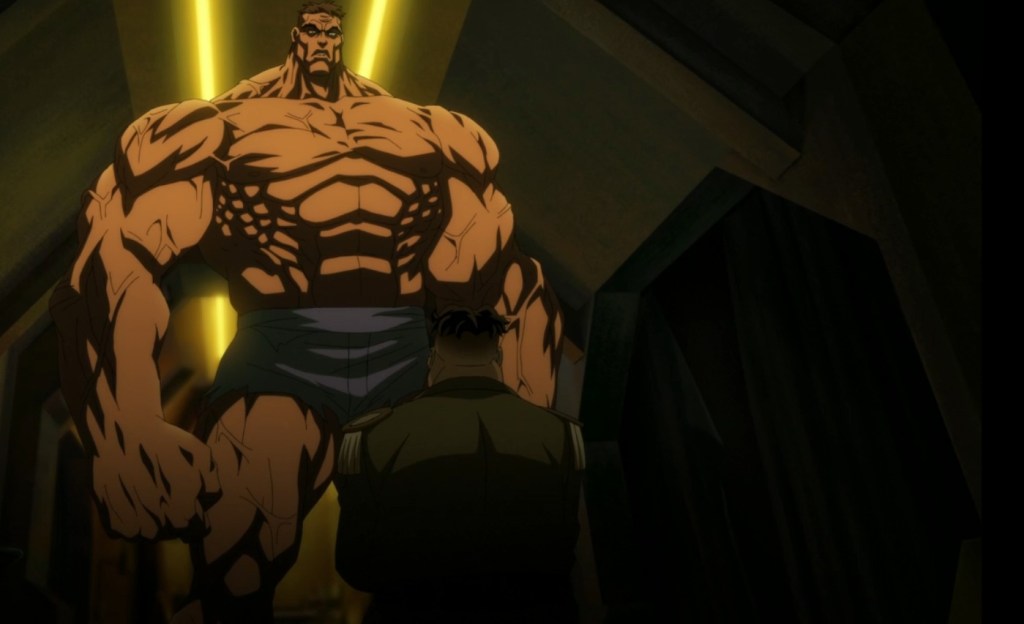
And I describe his actions as Hulking out because he’s enormous in this film. Much of the design work was explicitly patterned after the art style of Kelley Jones, the famous artist who provided covers during the original Knightfall saga before working on interiors of the Batman title along with writer Doug Moench. Whereas the artists who did the bulk of the page work were more comparatively traditional (but by no means less talented) in style, such as the aforementioned Graham Nolan and the late Jim Aparo, this over-the-top approach actually works well to put Bane across as a huge threat, reemphasizing that his Venom-induced super-strength and size is something to react to. We’ve been too used to the idea of Bane that he’s become watered down. Between the strong animation and the vibrant colors, this movie claws back his aura after years of misuse.
Following all that violence, we shift to a daytime scene of Bruce Wayne speaking to therapist Shondra Kinsolving – someone who I was very curious to see translated from the original story. This scene provides some of the better examples of exposition. Like in the comics, Bruce is referred to Shondra because his physical ailments have resulted from prolonged exhaustion. She mentions he was sent to her by Alfred under threat of him quitting, something that literally happens in the second half of Knightfall, and in The Dark Knight Rises. Shondra disregards Bruce’s dull playboy routine, stating that his falling out with Dick Grayson was made public by the tabloids. Cut to a shot of Dick leaving the Batcave with the Robin suit splayed all over the floor, reminiscent of this cover to New Teen Titans #39. The implication that Dick beefing with Bruce would be reported by TMZ is funny to me, but it’s also accurate to the books at the time. Dick was actually in the middle of planning his marriage to Starfire in the pages of New Teen Titans #100 (a disaster in many ways), and was going through a bit of a breakdown himself. But referencing his absence works wells to foreshadow his return to Gotham for Knightsend, which we know we’re getting going by both the trailer and the credits sequence invoking Nightwing.
Shondra then mentions that Bruce lost his second ward Jason Todd, and we cut to a clear reference to the Jim Aparo drawn cover to Batman: A Death in the Family. What’s great about this is that while Bruce tried to play off Dick’s leaving as just moving on, he goes completely silent at the mention of Jason. It’s both in character, and also informs us that he’s not gotten over that loss. It’s a trait that was on full display in the comics at the time, and is one of the truest adapted qualities in this film, not simply something used by Adams in the screenplay.
Shondra finishes by mentioning that Bruce has taken a “new intern at work”, Tim Drake. We see an image of Tim in the Batcave holding a batarang to Batman and Alfred, which reminded me of a similar scene in The New Batman Adventures, which would be a really deep cut reference if that was intentional. Also, calling Tim a work intern is funny because it recalls Terry McGinnis’ stated reason for hanging around Bruce Wayne in Batman Beyond, but it’s a decent explanation as to what this celebrity playboy whose previous adopted ward wound up killed in an Ethiopian fire is doing with yet another junior high student. Like in the comics, Tim’s father is still alive and he lives with him. There wasn’t ever much of a public explanation for Tim to be around Bruce other than they were eventual neighbors in Bristol County, so you might as well just call him an intern.
We cut to Arkham Asylum where Bane appears in full costume, kills a guard and plants explosives that set the grounds ablaze. This is way paired down from the entire issue of Batman #491, where the inmates are gradually freed before the building explodes and Batman arrives just in time to free Dr. Arkham from a Joker deathtrap. During the escape we saw several various villains such as Poison Ivy and Maxie Zeus. In this adaptation, we only see Jervis Tetch a.k.a. The Mad Hatter loudly mocking the passerby from inside his cell. I understand the decision to cut this scene down, but I sorely miss the chaotic events of #491. It ended on such an awesome final scene, presaging the torment that an already exhausted Batman was about to endure.
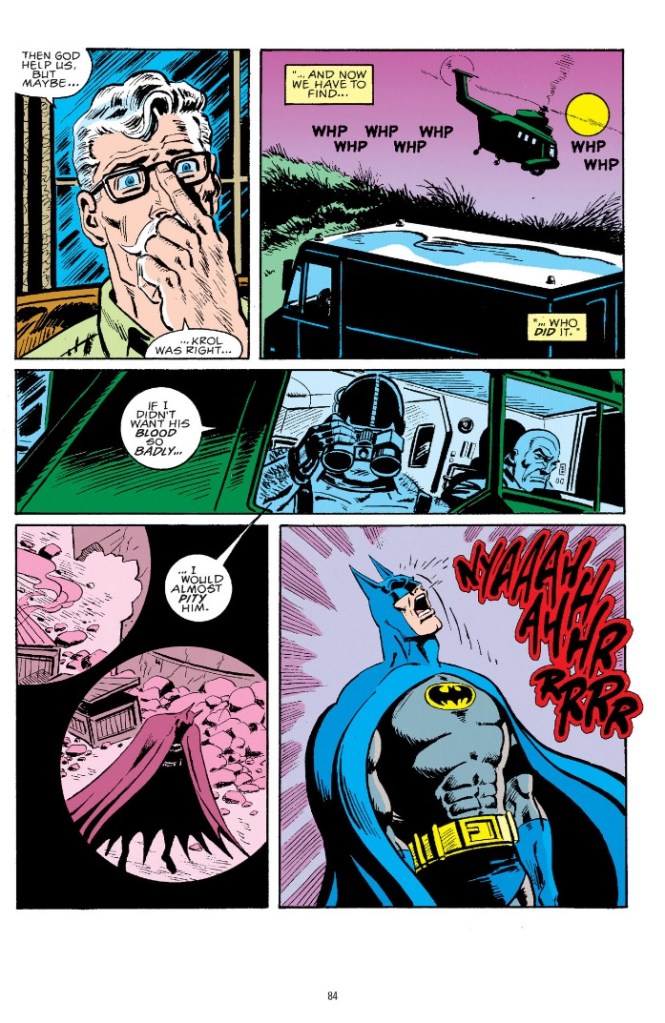
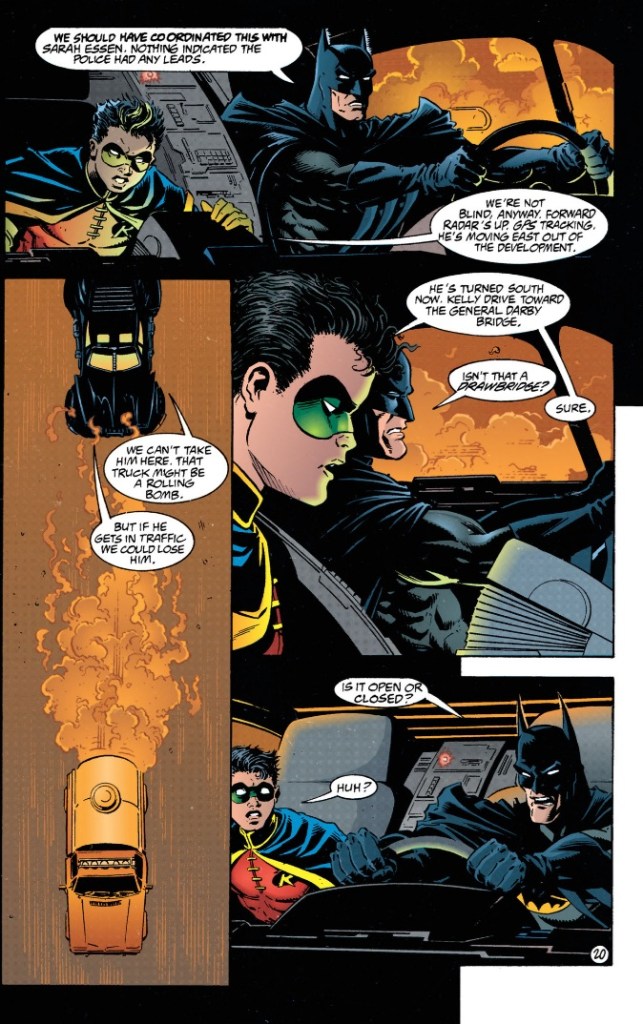
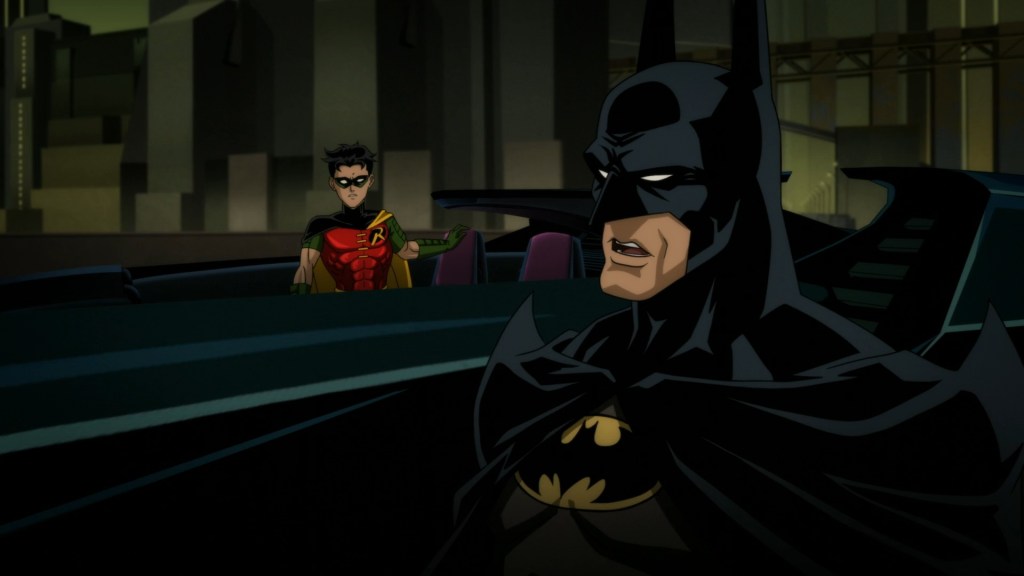
Instead, we smash-cut to the Batmobile revving up its engines and racing across the Gotham highways. Batman and Robin are on their way to stop the escaped inmates, with Robin commenting that Batman’s been going nonstop for the past two days without sleep. This was one of the opening scenes from the trailer, and right away I sensed a strong fidelity to the comics. It’s a brief scene, but it embodies similar moments that occurred in the first few issues of Knightfall – Batman and Robin working through clues as fast as they could while Robin comments on Batman’s deteriorating state. We get more exposition on how they’ve taken in Jean-Paul and are working to deprogram him, which I like because even though Batman’s being grumpy it’s an example of his humanitarian side referenced in the middle of a stressful period. But this is one of the few scenes we get with the Dynamic Duo, and it’s pretty darn faithful. Even details like the precise Batmobile design matching the unique version drawn by Norm Breyfogle (looking gorgeous in a 3-D rendering), and the location of the Mad Hatter being Tenniel Estates just like in the issue.
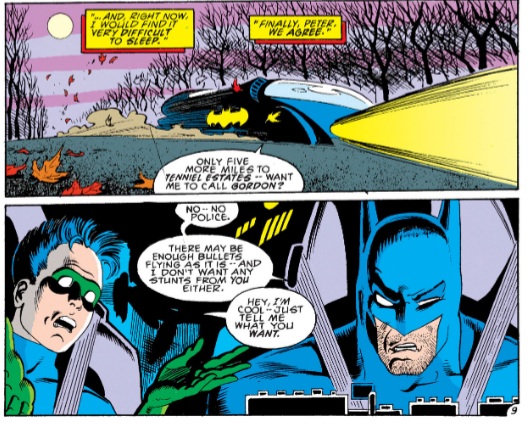
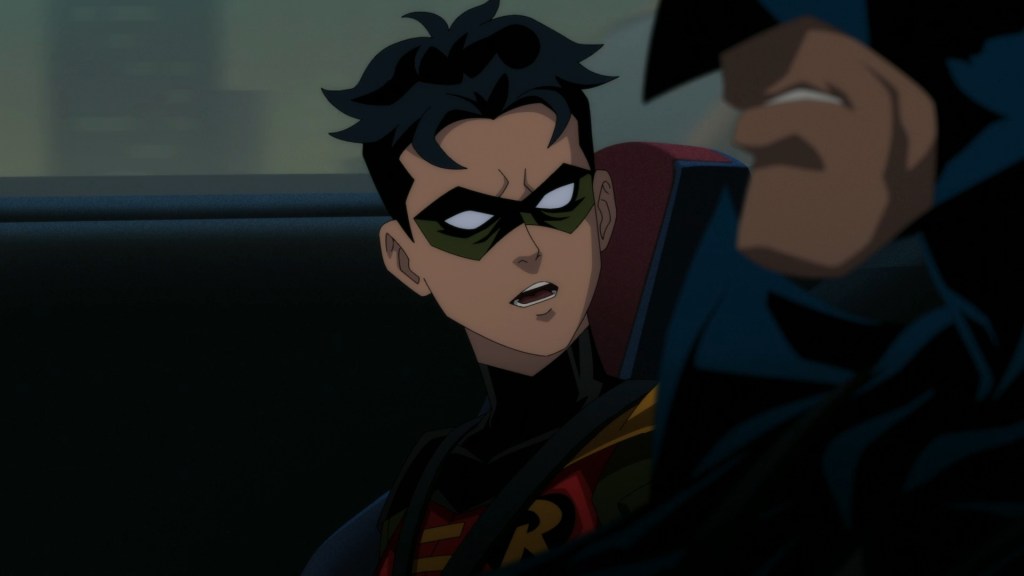
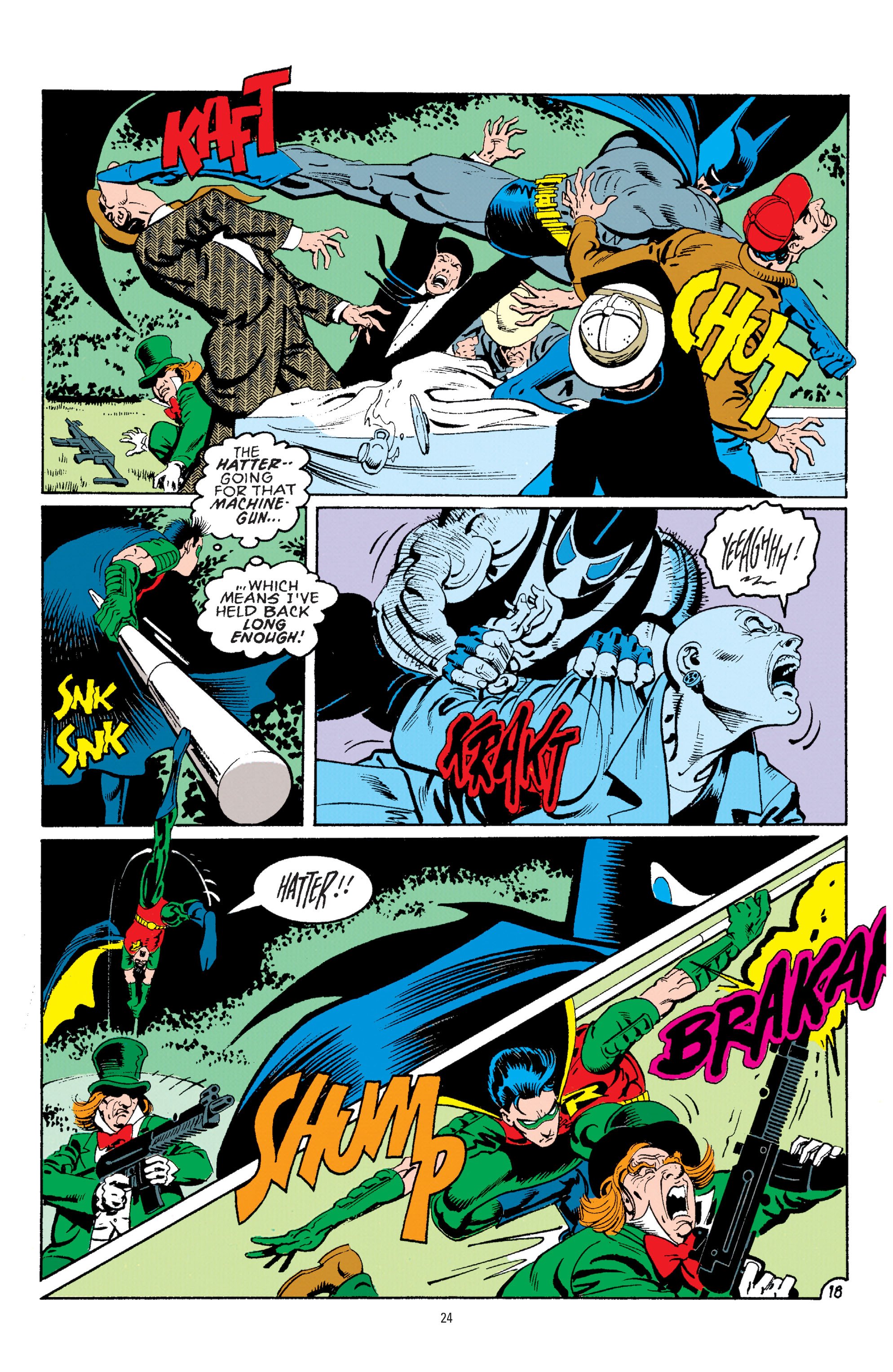
Much of the subsequent adventure is similar enough to the events of the comic, although there’s a lot that’s cut out. In Batman #492, Mad Hatter invites several criminals to his tea party for the purposes of discovering the identity of one responsible for the Arkham breakout, enlisting D-lister Film Freak as a patsy to track down and kill Bane (it doesn’t go well). In the film, the Hatter brainwashes several of his former henchmen and intends to murder them for leading to his arrest. Batman arrives and begins taking the goons down, but not without getting nicked across the cheek by a knife – something that Hatter loudly reacts to, informing the audience that such a small attack never reaches him. Hatter’s depicted as a screeching lunatic in this movie, which is typically how he is in the comics. Being used to the more tragic, multifaceted but still evil version in the animated series, it’s interesting watching him being a raving psychopath and remembering that it’s true to the source material. Likewise, just like in the comic, Hatter pulls a machine gun on Batman when his back is turned, prompting Robin to leap into action and save the day. Batman admonishes him for disobeying his order to stay in the car, and the two have a squint off.
While watching this movie for a second time, different creators began floating through my brain. For instance, the aforementioned Kelley Jones was an artistic consultant on the film. Norm Breyfogle was the penciller for the issue this scene was based on, but it was artist Staz Johnson who came to mind when looking at Batman and Robin. Specifically the moment just before Batman entered Tenniel Estates. The way Batman’s shoulders were horned reminded me of Johnson’s style in stories like Detective Comics issue #689. Johnson filled in as penciller for Chuck Dixon’s Detective Comics run for six issues before later enjoying a three year bid with Dixon in the page of the Robin title.